Showing posts with label Season Three. Show all posts

Monday, July 23, 2007

3.15 "A Quality of Mercy"

Season Three, Episode Fifteen

Written by: Rod Serling
Directed by: Buzz Kulik
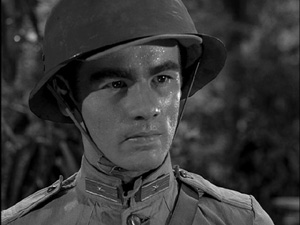
Pedantically taking its name from a line in The Merchant of Venice, A Quality of Mercy is an ineffective anti-war episode that, for all its brotherhood of man ideals, is detrimentally gimmicky, not to mention dated in its (unconscious?) racism. Set during WWII, Dean Stockwell is a gung-ho, cutthroat lieutenant in the American army who is sent to take command of a war-weary regimen bunkered down in the Philippines. The war is winding down, in its "last grimy pages," as Serling says in narration, and the Americans are restively watching a cave that's housing a group of sick and dying Japanese soldiers. The Americans want to bypass the cave when they move on, seeing an attack as cruel and unusual, but Stockwell won't have it. "We're gonna kill Japs, that's my job!" he shouts, berating his fellow Americans for what he sees as their cowardice, their having gone soft. "You talk like this is a football game," Albert Salmi's compassionate sergeant tells the odious Stockwell, "but this isn't a football game."

There are many more examples of that kind of popping, animated exchange in the opening scenes set in the American camp:
"They're Japs," says Stockwell.
"They're men!" answers Salmi. Or:
"How many men have to die before you're satisfied?"
"All of 'em!"

But Stockwell's lieutenant, in his bloodthirst, is a little cartoonish, though Stockwell restrains himself and avoids chewing the scenery. Serling's writing, however, is not so understated; Stockwell, through unspecified magic, is transported three years into the past and...as if it weren't enough to transport a man through time, I think he's turning Japanese, I really think so! Using Finian's Rainbow's ham-fisted theatrical conceit (but this time not played, at least intentionally, for laughs), Stockwell, now somehow Japanese, is forced to literally see the world, and specifically the war, through his enemy's eyes. A Quality of Mercy repeats its first half, nearly word for word, as Stockwell finds the Japanese in an analogous situation to the one he found himself in previously: in preparations for mopping up a cavebound group of wounded Americans. This time, Japanese lieutenant Dale Ishimoto plays the Stockwell part, leading the ruthless massacre, while Stockwell, in yellowface, finds himself playing the Salmi role of merciful dissenter. Oh, now he understands that men are still men, even in war, and that murdering the enemy is nothing to revel in, nor does it make you more of a man. (Too bad Truman didn't learn the same lesson, as the episode ends with Stockwell back on the American side as reports from Hiroshima come in.) I can appreciate Serling's misoguerric sentiments, but not the pompous script or silly execution, including, despite its noble intentions, a Mickey Rooney turn from Stockwell. Despite an affecting final few moments, like Stockwell's Japanese accent A Quality of Mercy is a bit too ridickerous.

For Netflix Purposes:
On Disc 13 of Image Entertainment's Twilight Zone DVDs.

Monday, July 16, 2007

3.13 "Once Upon a Time"

Season Three, Episode Thirteen

Written by: Richard Matheson
Directed by: Norman Z. McLeod

A cute critique of political reactionism, Once Upon a Time is one of the few, if the only, straight-up Twilight Zone comedies, featuring the consummate comedian Buster Keaton, his famously stony visage now marked by conspicuous wrinkles. Bookended by two sequences of clever silent-film pastiche—complete with title cards and a brilliant piano score by William Lava—the episode finds Keaton, playing a scientist's janitor, disgusted by the degradation of his decade, the 1890's—the noise, the expense, the prurience and the hustle and bustle. (He's up-ended by a high-wheel bicycle moving at the absurdly rapid speed limit of eight miles per hour!) Finding a time-machine helmet in his master's laboratory, he decides to visit what he imagines must be the peaceful utopia of the future, and travels to 1960, where he finds himself in the middle of automobile traffic, a future immediately recognized as far worse than the past marked by its old-time bikes. The episode's sound returns as the din of shouts and traffic horns deafen, while Keaton takes in his noticeably more expensive and salacious surroundings.

Written by Richard Matheson, who would later insist that his original script was much funnier, and directed by Norman Z. McLeod, who in his heyday had directed many of post-silent cinema's classic crackerjack comedians (the Marx Bros., W.C. Fields, Danny Kaye), Once Upon a Time must surely be the last traditional silent film produced in America. Plottily thin, it's essentially an ode to Buster Keaton and his silent comedies of yore, and welcomely it eschews sentimentality, choosing instead to pay tribute to his masterful oeuvre with solid work in turn. It's certainly not Keaton's most hilarious or inventive turn, but it's strong nevertheless, full of prop-humor yuks, as Keaton attempts to accustom himself to the gadgetry of the post-war era, and time-honored physical gags; a sequence in the middle, in which his newfound friend of the future (Stanley Adams) helps a pantsless Keaton evade a trailing policeman is classic Keaton and, though brief, makes the episode worth seeing, at least for fans. Keaton's a marvelous casting choice, not only for his deft comic timing but because he works exceptionally well as a fish-out-of-water in the modern world, as his character ought; it's alarming for the audience to discover that not only is Buster Keaton alive, but he has the ability to speak.

Adams, however, is dreadfully miscast and despoils the episode's charm, moreso than the oft-blamed—this isn't a particularly popular episode—dragging middle sequences at a repair shop, which were filmed weeks after wrap by a different director, Les Goodwin. Adams' gestural, exaggerated performance seems to belong more to the silent era; despite the fact that's he's meant to be an avatar of modernity, he comes across as though he'd be more at home in the 1890's than even Keaton.

Keaton can't wait to get back his temporal home, and at last Adams declares his intentions to accompany him, yearning for "those halcyon days". But his imagined past is as misguided as Keaton's imagined future, and when Adams arrives in 1890, he's soon at his wit's end—there are no comfortable mattresses, electronic devices, and so on; hell, there isn't even any sound or color! Keaton, sick of his whining, pops the helmet on his head and sends him home, as Serling reminds the viewer to "stay in your own backyard...and if possible, assist others to stay in theirs." It's a pointed attack on American conservatives, who to this day are still advocating for a return to the "good old days", a return to the mythical American past. It seems every generation has a tendency to romanticize the ones before it, without realizing how tethered they are to their own place in time nor how the past was not actually as they imagine it to have been. But casting Keaton gives the film another subtext, serving to point out his obsolescence in modern film culture specifically and, on a greater scale, to demonstrate just how much the world has changed; Keaton, who struggled to find work after the pictures learned to talk, just doesn't belong among us anymore. Mourn it if you choose, but Once Upon a Time plays it for laughs.

For Netflix purposes:
On Vol. 10 of Image Entertainment's Twilight Zone DVD Collection.

Thursday, July 12, 2007

3.05 "A Game of Pool"

Season Three, Episode Five

Written by: George Clayton Johnson
Directed by: Buzz Kulik

The writer stares at a blank page, frustrated that his prose might never dig as deeply into the heart as Agee's, or that his poetry not dig into the soul like Shakespeare's, and decides to either give up writing altogether or at least take another drink. The whisky boiling in his veins, he musters to courage to decide that even if he could be great, the best, he wouldn't want it anyway! Because, hey yeah, being the best is actually a curse! Uh, uh, yeah, yeah, it would be Hell!

Such a scene, one imagines, describes how George Clayton Johnson began writing his teleplay for A Game of Pool, an exploration into the nature of the quest for greatness, whether in art, business, politics or, specifically to the episode, pool. Jack Klugman plays a master cuesman, introduced ranting and raving in a sadly empty pool hall about how great he is, underappreciated too, and begging for one game against the champ that overshadows him, Fats Brown—who's, inconveniently, dead—to prove his talent. Of course, in the twilight zone, such wishes always tend to come true, and in no time Fats (Jonathan Winters, just fine) arrives, custom cue in tow, ready to give him that game. But the stakes? Life and death.

Although it's hard to imagine death as being such an adventurous wager when the appearance of a ghost has essentially proved the existence of an afterlife. But I suppose that's really neither here nor there; they play a long game during which plenty of philosophical subjects are briefly addressed; being a George Clayton Johnson episode (Nothing in the Dark, Kick the Can) there's plenty of talk about death and mortality, but the episode's central focus is on the meaning of life. "There's more to life than this pool hall," Fats advises, reproaching Klugman for having spent his entire life cooped up in that Randolph Street basement; as Klugman admits, it's been years since he went out with a girl or to a movie (incidentally, two of my favorite things to do!) The price of training for greatness has, for Klugman, who gives a marvelously bitter, insecure and desperate performance, been at the expense of what makes life worth living; in the figurative sense, he is already dead, so why not bet his life on a game?

Particularly since we've already seen, in the shot that introduces Fat, knocking the balls around up in the clouds, that Heaven has a pool table. The "game", which is actually a long series of many individual rounds (a point per ball in a three hundred point game), comes down to a single ball; it's Fats' shot, and he seems to fudge it intentionally, handing Klugman the victory by leaving him with an easy pocket-hanger. Klugman is warned that he "might win more than he bargained for"; he ignores it, but the exhortatory portent comes to pass: now the cosmic billiards champion, though no one is present to see it, Klugman is left as he was at the episode's beginning—entirely alone, talking to the walls and the hanging portraits. For Fats, the loss is liberating, and, as Serling lets us know in the closing narration, he has gone fishing. (In heaven?) Klugman, however, is bound to take over Fats' undesirable old job (after his death, presumably years later), to forever protect his title against all the young chumps begging for a game against the best.

Being the champion, according to A Game of Pool, isn't all that it's cracked up to be; in fact, as Fats mentions in the dialogue during the game, people need champions more than they need to be them so that they have something superior to measure themselves against, something to inspire them to work harder. (Sounds like capitalist propaganda!) But according to Marc Scott Zicree's The Twilight Zone Companion, an essential resource for any fan and particularly this project, the televised ending was not Johnson's; in his original finale, which he preferred, Klugman loses the game and Fats, rather than take his life, damns him to an existence of more vain practice and, finally, death in meaningless obscurity. "If you'd beaten me," Fats gloats in the unfilmed script, "you'd have lived forever." Philosophically it's a tremendously different ending, and not just a small matter of taste as Zicree suggests, that would require a good deal of alteration in the tautly scripted episode, thusly making it difficult to know for sure what parts of the script ought to actually be ascribed to Johnson. His ending is much harsher than the one that aired in which, though Klugman is sympathetically damned (in heaven?), the audience has been freed to not worry so much about being the best bar none, just the best you can be. Anyhow, as it often works out, today's mediocrity is tomorrow's legend.

But for Johnson, according to his original, unaltered script, being the best really is all that it's cracked-up to be. "There are certain satisfactions" to being the best, Fats admits during the game, to having your picture on the wall of Clancy's Poolroom. After the writer's rant regarding the undesirability of supremacy, his confidence wanes, and he slumps at the desk. All I want, he moans, is to be remembered in greatness. As it stands, George Clayton Johnson, talent though he was, has merely, regrettably faded away.

For Netflix purposes:
On Vol. 3 of Image Entertainment's Twilight Zone DVD Collection.

Tuesday, July 10, 2007

3.09 "Deaths-Head Revisited"

Season Three, Episode Nine

Written by: Rod Serling
Directed by: Don Milford

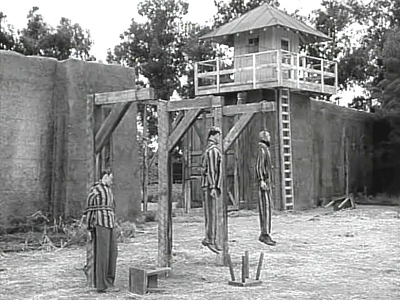
Wrathful and plaintive, vicious and humanistic, Deaths-Head Revisited (the title is a rather dark and coarse play on the title of Evelyn Waugh's famous comic novel), is, specifically, a pointed and poetic assessment of Nazi barbarism during World War Two, but also an examination of war in general, using the Holocaust symbolically as simply the most egregious example of modern warfare; that is, the episode's sympathy for the victims of war does not stop at European Jews. Porcine, in stature and in character, and gleeful, erstwhile Nazi officer Captain Lutze (Oscar Beregi), alias Herr Schmidt, takes a trip to das Vaterland from his safe South American hideout, a nostalgic vacation down memory lane; he visits, specifically, Dachau, the quaintly, charmingly scenic town now synonymous with human cruelty, where he was once stationed in his days as a merciless officer. (The episode is notable not least for its set design, a recreation of a concentration camp that, for low-budget television, is surprisingly palpable.) Feeling no shame, guilt or remorse, he wanders the grounds, enthusiastically re-envisioning the horrors he inflicted there; hallucinated corpses appear, for a moment, hanging from dusty gallows, and Lutze shows hints of a satisfied grin. Ah, the good old days.

Soon, however, the flashbacks take on a tactile nature; Lutze's memories are anthropomorphized in the form of a former inmate, Becker (Joseph Schildkraut), who appears to the erstwhile captain in ghost-form. Lutze mistakes him for the grounds' living caretaker; in a way, Becker acknowledges, he is—minus the "living" part. Becker proceeds to berate Lutze with effusive, accusatory speeches that in the hands of a lesser actor would've descended into pretentious speechifying; here, they sting, and director Don Milford knows how to keep the nightmare afloat: without spatial consistency, as in the logic of a (bad) dream, Lutze is transported around the camp and into the old barracks where he is confronted by a ghostly pack of former inmates. Seen in large groups and in canted angles, dressed in white against black backgrounds, they pose an awfully frightening image, even for me and I had nothing to do, personally, with National Socialism or the Final Solution. For Lutze it proves to be unbearable; he is driven mad by the overwhelming guilt, both personal and legal, handed-down to him by his spectral victims/judges, who, following the "fair trial" they have the decency to give him (while he is unconscious), cosmically sentence him to insanity. Though it claims otherwise—"this is not hatred," Becker explains, "it is retribution. This is not revenge, it is justice"—Serling's script is vicious and vengeance-minded, though not unduly so.

Broadcast during the Adolph Eichmann trial, Deaths-Head Revisited offers a scoffingly sharp rebuke of the "Nuremberg" defense that was Eichmann's mode of exculpatory apologia, as it was for many of the captured and tried post-war Nazis. "I was a soldier," Lutze declares in passionate defense. "You were a sadist," Becker counters as the howls of Lutze's victims bellow in the background. The ghosts of war's victims can never be put to rest, placated and sent away; they are a permanent fixture on the cultural and psychological landscape of the world we've wrought with constant combat. Deaths-Head Revisited works well on a very specific and literal level, but it also hints at a commentary on the essential nature of soldierhood, that war never has the benefit of moral clarity or justifiability, and soldiers rarely have the opportunity to exercise the power of their consciences.

When Becker levels charges at Lutze for killing and torturing not only men but women, children and infants, it evokes, in my modern mind, thoughts of Vietnam's My Lai massacre, and though that atrocity succeeded Deaths-Head... by eight years, the horrific violence of the War in Southeast Asia couldn't have been far from Serling's mind, as the Vietnam War is a frequently recurring subtext in The Twilight Zone. Serling closes-out the episode with one of his most moving final narrations, which explicitly, and uncharacteristically, announces the episode's moral in relation to the real world:

"...All the Dachaus must remain standing. The Dachaus, the Belsens, the Buchenwalds, the Auschwitzes—all of them. They must remain standing because they are a monument to a moment in time when some men decided to turn the Earth into a graveyard. Into it they shoveled all of their reason, their logic, their knowledge, but worst of all, their conscience. And the moment we forget this, the moment we cease to be haunted by its remembrance, then we become the gravediggers. Something to dwell on and to remember, not only in the Twilight Zone but wherever men walk God's Earth."

Of course men turning the earth into a graveyard has hardly stopped in the decades since the Second World War, nor was it particularly new to the Nazis, and Deaths-Head Revisited is all the more effective, and devastating, for its apparent timelessness.

For Netflix purposes:
On Vol. 6 of Image Entertainment's Twilight Zone DVD Collection.

Thursday, July 5, 2007

3.14 "Five Characters in Search of an Exit"

Season Three, Episode Fourteen

Written by: Rod Serling
Directed by: Lamont Johnson

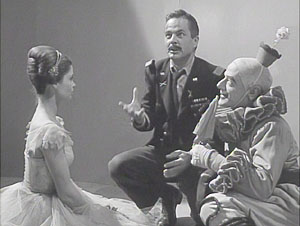
Five Characters in Search of an Exit is one of the most incredibly silly episodes of The Twilight Zone, even though the eponymous characters, for the most part, act very seriously throughout, and its plot description sounds like the set-up of a bad joke: a clown, a ballerina, a hobo, a bagpipe player and a military officer find themselves inhabiting a tall cylinder, rather than walking into a bar, with no memories of who they are or how they got there. It's an intriguingly simple and mysterious premise, and the episode plays out as one of the series' most self-conscious and autocritical; as the audience watches and begins to hypothesizing as to what might be going on, the characters join in as well, ticking off the various theories, including the obvious and the more complex, and quickly dismissing them, frustrating the audience by relentlessly teasing them as their attempts to make sense of the episode are smarmily discarded by a playful Serling. "We don't actually exist"; "we're characters in a dream"; "we're on a spaceship"; etc. until the clown declares there can be no other reasonable explanation other than that they are in Hell.

I suppose he's not too far off; the suspense builds right up until the end (although like many episodes of The Twilight Zone it'd be more effective, particularly on repeated viewings, at an abbreviated running time) as the newly arrived officer, played with desperation by the notable William Windom, passionately inspires his resigned fellow prisoners to attempt escape; they stand on one another's shoulders, and when Windom finally gets over the canister top, he slips and falls into a mound of snow. It's revealed that they are all dolls, thus their cartoonish archetypes, inhabiting a charity toy collection drive barrel. Oh. I guess you could argue the episode is a metaphor for the way that human beings find themselves trapped in a prison of their own complacency, how our world is a narrow loveless hell populated by people defined by nothing more than their profession, but it's hard to shake the feeling that this isn't anything more than a half-assed concept Serling got while staggering home drunk past a bell-ringing Salvation Army major. It's cleverly done, but deliberately so absurd as to surprise even the most hardened Twilight Zone veteran that the twist feals cheap and unduly snarky.

For Netflix purposes:
On Vol. 21 of Image Entertainment's Twilight Zone DVDs.

Wednesday, June 6, 2007

3.21 "Kick the Can"

Season 3, Episode 21

Directed by: Lamont Johnson
Written by: George Clayton Johnson

George Clayton Johnson was wise beyond his years, spending the early '60s—when he was only in his thirties—writing a string of moving and mature teleplays on the nature of aging and death; indeed, the first story he ever sold was entitled, "All of Us Are Dying", a blunt statement that just about sums up the mortality-obsessed worldview expressed in his writings. His first episode of The Twilight Zone's third season, Nothing in the Dark, deals with an elderly woman's coming to terms with her own imminent demise, but frankly, though sweet, it's a tad cloying in the way it plays out. (Read our review of it here.) His next episode, Kick the Can, threatens to succumb to the same sort of sappiness, but through a last minute reversal of tone it becomes an effectively tragic tale about loneliness and the forsaken character of old age.

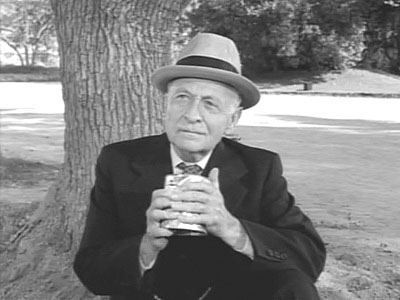
Charles (Ernest Truex, fiesty) may have a bed at Sunnyvale Rest on Tranquility Lane, but he doesn't quite live there, if you know what I mean. Surrounded by zonked-out, senile and half-blind droolers, he still has a spunk about him and an unwillingness to go gently into that good twilight of soup and half-a-sandwich lunches. Against the backdrop of stationary senescents that opens the episode, tow-headed kids are seen playing the children's classic kick-the-can. Charles spots their can and selfishly steals it, against the protests of the children. "Hey mister, that's our can, we're playing with it," one pleads, but Charles, gripping it madly with a far away look in his eyes, is completely oblivious to his imploration.

That's because he's suddenly too preoccupied with pondering the nature of age. Is age an effect of time, or is it merely a state of mind? Charles is fascinated by the idea that the Fountain of Youth might be just a way of thinking, but his cantankerous roommate and lifelong pal Ben (Russell Collins) wants no talk of such silliness. He peers out the window, crotchetily complaining about those dang noisy kids, loud enough to "wake the dead", or at least just the elderly fusspots near death living at the home. Charles is more forgiving, admiring their sense of play and remarking, in reference to the retirement home's grounds, "kids can't resist going where the grass is." (Certainly a cleverly subtle joke from well-known marijuana-legalization advocate Johnson.)

In contrast to the playing children, Charles' fellow septua- and octo-genarian housemates are nothing but "vegetables on a porch", seemingly unflappable until something happens—then they're all nosy and crabby commentators in typical senior citizen fashion. "Let him drown himself if he wants," one remarks of Charles as he dances in a sprinkler.

"We all get old," is the repeated, defeatist refrain that Charles just cannot accept; he becomes convinced that the secret to juvenescence is in play, and that a game of kick-the-can will restore their youth. "[But] I can't play kick the can alone!" he entreats his fellow residents, with a fervor on par with Howard Beale. "Wake up! This is your last chance!" Or, "I want you to get up, and go to your windows, and shout, 'I'm old as hell, and I'm not gonna take it anymore!'"

Preceding this outburst is a rather touching scene as the old timers discuss the changes that accompany old age. "It's the running I miss the most," one remarks, to which another woman agrees. This coaxed-out spirit of mournful melancholy is what ultimately inspires all the seniors to finally agree to play Charles' game. All but Old Ben, that is, who wants nothing to do with it; Ben won't go because, as Charles asserts, he's afraid—afraid to look foolish, afraid to make a mistake; Johnson, playing up a prominent theme from Nothing in the Dark, is saying that it's not only a surrendering-to-the-inevitable mindset that makes people "old", but that it's a driving sense of fear, the sort that adults of any age often feel and what ultimately separates them from their youthful counterparts. Eventually, Ben rouses the home's president, played by notable character actor John Marley (who got a bedful of horse's head in The Godfather), and asks him to put a stop to this foolishness.

Of course, when they get outside there are no old folks, just children at play. It worked! Charles was right, there is still magic in the world! This expected and inevitable happy ending almost makes Kick the Can nothing more than pleasant and well-acted feel-good fare, but then comes the tragedy--Ben, now the only old person left, begs his old friend Charles, now a young boy, to take him with them, to restore his youth. The small boy stares frightenedly at Ben, before simply running off to Ben's despair, a moment of devastating abandonment later revisited by Serling in On Thursday We Leave for Home. But the scene mirrors the opening scene, in which Charles thinks he is leaving the rest home to live with his son. When his son arrives there's a single line: "I didn't say you could come home, I said we'd talk about it." Charles exits from his son's car, understanding Sunnyvale is now his final stop on the merry-go-round of life. Charles' son abandons him, just as Charles abandons Ben, because that's what children do; that's where Kick the Can's true pathos lies.

For Netflix purposes:
On Vol. 3 of Image Entertainment's Twilight Zone DVDs.
Monday, May 21, 2007

3.16 "Nothing in the Dark"

Season 3, Episode 16

Directed by: Lamont Johnson
Written by: George Clayton Johnson

Exceptional episodes of The Twilight Zone generally fall into two categories: the allegorical, usually realted to a larger and specific American issue like war or racism, and the philosophical, which tend to offer sapient insights into broader profound topics, such as death. Nothing in the Dark is an example of the latter; Gladys Cooper, a marvelous actress known for her work on the English stage (and some supporting roles in American film and television), plays Wanda Dunn—as in done—an old woman terrified of dying, or more specifically of Death himself in anthropomorphized form. According to Serling's opening narration she has fought 1,000 battles with him and always won but, of course, as The Seventh Seal has taught us, not to mention all the real-world cemeteries, Death is not the kind to accept such defeats graciously and move on.

Cooper's character lives "cooped-up" in a small, decrepit basement apartment to which she never opens the door—not for the gas man, not for the man from the city, not for nobody. They're all elaborate ruses, she's sure, a series of pretenses for Death to get in and get her. So when a young and dashing Robert Redford appears outside her door, as a police officer who's been shot, she is faced with quite a dilemma. Can she just leave him to bleed to death? Surely allowing someone so handsome, and a cop no less, to die is a capital offense and would result in her death anyway, at the hands of the courts. "It's not fair, it's not fair," she sympathetically and repeatedly rues, ultimately surrendering to compassion—she takes the wounded man in and nurses him to health.

Redford is nothing but unthreatening and gracious for her help, so Wanda begins to trust him. Not to mention she touched him but did not die. But as anyone who's ever seen The Sting knows, that Redford fellow's a con-man who ought never be trusted. Of course, Wanda had no access to a movie made over a decade later, not even in the twilight zone, and so she makes the fatal mistake of letting him recuperate in her apartment. Just then a man forces his way into the apartment, almost killing Wanda by scaring her half to death and she collapses into unconsciousness. When she comes to, the man identifies himself not as Death but as a contractor for the city who has orders to tear down her building, which has been declared condemned.

The contractor's scene is an extended double entendre, clever to a fault as every line has a double meaning that'd lead you to believe that he is the long-awaited Mr. Death. The cleverest of these come in his grand speech about why he does what he does, also giving the episode some spiritual heft: "I just clear the ground so other people can build," he defensively asserts, implying it's the way of the world. The "old make way for the new."

While taking small swipes at the heartlessness of urban "renewal", Nothing in the Dark, written by the man who went on to pen Logan's Run (another rumination on age and death), is essentially one long comforting and saccharine assuagement, as the protagonist makes her way from an overwhelming fear of expiration to enlightened understanding and acceptance. (spoiler alert) "It's not me you're afraid of," Death, revealed to be Redford, tells Wanda, "it's the unknown," and though he created an elaborate scam to get into her apartment, he's gone to such great lengths in order to show her that death isn't such a scary trip after all, and Death's not such a bad guy, just misunderstood. Well, sure death won't seem so frightening when Redford the Dreamboat is the Glam Reaper; when he beckons for Wanda to take his hand and come with him, her reluctance seems absurd—I would do anything a young Robert Redford asked me to do without blinking an eye.

But the episode also functions as a warning about how being overly preoccupied with death and dying results in a life not worth living, trapping us in a "box" like the cramped flat that Ms. Dunn inhabits. As Bertholt Brecht once cautioned: "Do not fear death so much, but rather the inadequate life." Though the episode's a tad cloying, Cooper's tender performance lends Nothing in the Dark some genuine pathos; besides, it's remarkably rare and somewhat refreshing to, nowadays, see something on television asking us not to be afraid. As Serling closes the episode: "There was an old woman...who had discovered in the minute last fragment of her life that there was nothing in the dark that wasn't there when the lights were on." So take a deep breath America and relax.

For Netflix purposes:
On Vol. 1 of Image Entertainment's Twilight Zone DVDs.