Thursday, July 12, 2007

3.05 "A Game of Pool"

Season Three, Episode Five

Written by: George Clayton Johnson
Directed by: Buzz Kulik
The writer stares at a blank page, frustrated that his prose might never dig as deeply into the heart as Agee's, or that his poetry not dig into the soul like Shakespeare's, and decides to either give up writing altogether or at least take another drink. The whisky boiling in his veins, he musters to courage to decide that even if he could be great, the best, he wouldn't want it anyway! Because, hey yeah, being the best is actually a curse! Uh, uh, yeah, yeah, it would be Hell!

Such a scene, one imagines, describes how George Clayton Johnson began writing his teleplay for A Game of Pool, an exploration into the nature of the quest for greatness, whether in art, business, politics or, specifically to the episode, pool. Jack Klugman plays a master cuesman, introduced ranting and raving in a sadly empty pool hall about how great he is, underappreciated too, and begging for one game against the champ that overshadows him, Fats Brown—who's, inconveniently, dead—to prove his talent. Of course, in the twilight zone, such wishes always tend to come true, and in no time Fats (Jonathan Winters, just fine) arrives, custom cue in tow, ready to give him that game. But the stakes? Life and death.

Although it's hard to imagine death as being such an adventurous wager when the appearance of a ghost has essentially proved the existence of an afterlife. But I suppose that's really neither here nor there; they play a long game during which plenty of philosophical subjects are briefly addressed; being a George Clayton Johnson episode (Nothing in the Dark, Kick the Can) there's plenty of talk about death and mortality, but the episode's central focus is on the meaning of life. "There's more to life than this pool hall," Fats advises, reproaching Klugman for having spent his entire life cooped up in that Randolph Street basement; as Klugman admits, it's been years since he went out with a girl or to a movie (incidentally, two of my favorite things to do!) The price of training for greatness has, for Klugman, who gives a marvelously bitter, insecure and desperate performance, been at the expense of what makes life worth living; in the figurative sense, he is already dead, so why not bet his life on a game?

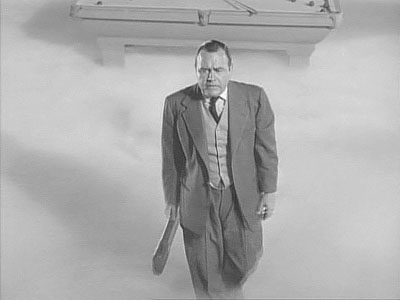
Particularly since we've already seen, in the shot that introduces Fat, knocking the balls around up in the clouds, that Heaven has a pool table. The "game", which is actually a long series of many individual rounds (a point per ball in a three hundred point game), comes down to a single ball; it's Fats' shot, and he seems to fudge it intentionally, handing Klugman the victory by leaving him with an easy pocket-hanger. Klugman is warned that he "might win more than he bargained for"; he ignores it, but the exhortatory portent comes to pass: now the cosmic billiards champion, though no one is present to see it, Klugman is left as he was at the episode's beginning—entirely alone, talking to the walls and the hanging portraits. For Fats, the loss is liberating, and, as Serling lets us know in the closing narration, he has gone fishing. (In heaven?) Klugman, however, is bound to take over Fats' undesirable old job (after his death, presumably years later), to forever protect his title against all the young chumps begging for a game against the best.

Being the champion, according to A Game of Pool, isn't all that it's cracked up to be; in fact, as Fats mentions in the dialogue during the game, people need champions more than they need to be them so that they have something superior to measure themselves against, something to inspire them to work harder. (Sounds like capitalist propaganda!) But according to Marc Scott Zicree's The Twilight Zone Companion, an essential resource for any fan and particularly this project, the televised ending was not Johnson's; in his original finale, which he preferred, Klugman loses the game and Fats, rather than take his life, damns him to an existence of more vain practice and, finally, death in meaningless obscurity. "If you'd beaten me," Fats gloats in the unfilmed script, "you'd have lived forever." Philosophically it's a tremendously different ending, and not just a small matter of taste as Zicree suggests, that would require a good deal of alteration in the tautly scripted episode, thusly making it difficult to know for sure what parts of the script ought to actually be ascribed to Johnson. His ending is much harsher than the one that aired in which, though Klugman is sympathetically damned (in heaven?), the audience has been freed to not worry so much about being the best bar none, just the best you can be. Anyhow, as it often works out, today's mediocrity is tomorrow's legend.

But for Johnson, according to his original, unaltered script, being the best really is all that it's cracked-up to be. "There are certain satisfactions" to being the best, Fats admits during the game, to having your picture on the wall of Clancy's Poolroom. After the writer's rant regarding the undesirability of supremacy, his confidence wanes, and he slumps at the desk. All I want, he moans, is to be remembered in greatness. As it stands, George Clayton Johnson, talent though he was, has merely, regrettably faded away.

For Netflix purposes:
On Vol. 3 of Image Entertainment's Twilight Zone DVD Collection.

Tuesday, July 10, 2007

3.09 "Deaths-Head Revisited"

Season Three, Episode Nine

Written by: Rod Serling
Directed by: Don Milford

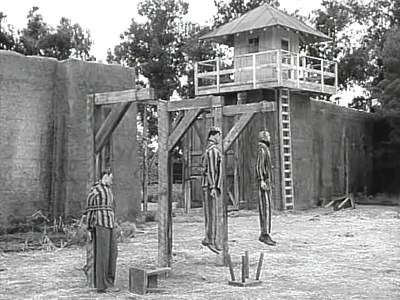
Wrathful and plaintive, vicious and humanistic, Deaths-Head Revisited (the title is a rather dark and coarse play on the title of Evelyn Waugh's famous comic novel), is, specifically, a pointed and poetic assessment of Nazi barbarism during World War Two, but also an examination of war in general, using the Holocaust symbolically as simply the most egregious example of modern warfare; that is, the episode's sympathy for the victims of war does not stop at European Jews. Porcine, in stature and in character, and gleeful, erstwhile Nazi officer Captain Lutze (Oscar Beregi), alias Herr Schmidt, takes a trip to das Vaterland from his safe South American hideout, a nostalgic vacation down memory lane; he visits, specifically, Dachau, the quaintly, charmingly scenic town now synonymous with human cruelty, where he was once stationed in his days as a merciless officer. (The episode is notable not least for its set design, a recreation of a concentration camp that, for low-budget television, is surprisingly palpable.) Feeling no shame, guilt or remorse, he wanders the grounds, enthusiastically re-envisioning the horrors he inflicted there; hallucinated corpses appear, for a moment, hanging from dusty gallows, and Lutze shows hints of a satisfied grin. Ah, the good old days.

Soon, however, the flashbacks take on a tactile nature; Lutze's memories are anthropomorphized in the form of a former inmate, Becker (Joseph Schildkraut), who appears to the erstwhile captain in ghost-form. Lutze mistakes him for the grounds' living caretaker; in a way, Becker acknowledges, he is—minus the "living" part. Becker proceeds to berate Lutze with effusive, accusatory speeches that in the hands of a lesser actor would've descended into pretentious speechifying; here, they sting, and director Don Milford knows how to keep the nightmare afloat: without spatial consistency, as in the logic of a (bad) dream, Lutze is transported around the camp and into the old barracks where he is confronted by a ghostly pack of former inmates. Seen in large groups and in canted angles, dressed in white against black backgrounds, they pose an awfully frightening image, even for me and I had nothing to do, personally, with National Socialism or the Final Solution. For Lutze it proves to be unbearable; he is driven mad by the overwhelming guilt, both personal and legal, handed-down to him by his spectral victims/judges, who, following the "fair trial" they have the decency to give him (while he is unconscious), cosmically sentence him to insanity. Though it claims otherwise—"this is not hatred," Becker explains, "it is retribution. This is not revenge, it is justice"—Serling's script is vicious and vengeance-minded, though not unduly so.

Broadcast during the Adolph Eichmann trial, Deaths-Head Revisited offers a scoffingly sharp rebuke of the "Nuremberg" defense that was Eichmann's mode of exculpatory apologia, as it was for many of the captured and tried post-war Nazis. "I was a soldier," Lutze declares in passionate defense. "You were a sadist," Becker counters as the howls of Lutze's victims bellow in the background. The ghosts of war's victims can never be put to rest, placated and sent away; they are a permanent fixture on the cultural and psychological landscape of the world we've wrought with constant combat. Deaths-Head Revisited works well on a very specific and literal level, but it also hints at a commentary on the essential nature of soldierhood, that war never has the benefit of moral clarity or justifiability, and soldiers rarely have the opportunity to exercise the power of their consciences.

When Becker levels charges at Lutze for killing and torturing not only men but women, children and infants, it evokes, in my modern mind, thoughts of Vietnam's My Lai massacre, and though that atrocity succeeded Deaths-Head... by eight years, the horrific violence of the War in Southeast Asia couldn't have been far from Serling's mind, as the Vietnam War is a frequently recurring subtext in The Twilight Zone. Serling closes-out the episode with one of his most moving final narrations, which explicitly, and uncharacteristically, announces the episode's moral in relation to the real world:

"...All the Dachaus must remain standing. The Dachaus, the Belsens, the Buchenwalds, the Auschwitzes—all of them. They must remain standing because they are a monument to a moment in time when some men decided to turn the Earth into a graveyard. Into it they shoveled all of their reason, their logic, their knowledge, but worst of all, their conscience. And the moment we forget this, the moment we cease to be haunted by its remembrance, then we become the gravediggers. Something to dwell on and to remember, not only in the Twilight Zone but wherever men walk God's Earth."

Of course men turning the earth into a graveyard has hardly stopped in the decades since the Second World War, nor was it particularly new to the Nazis, and Deaths-Head Revisited is all the more effective, and devastating, for its apparent timelessness.

For Netflix purposes:
On Vol. 6 of Image Entertainment's Twilight Zone DVD Collection.
Monday, July 9, 2007

2.28 "Will the Real Martian Please Stand Up?"

Season Two, Episode Twenty Eight

Written by: Rod Serling
Directed by: Montgomery Pittman

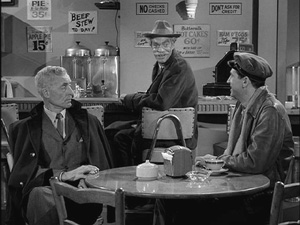
"Is this a diner or Gestapo headquarters?" a fussy old man (John Hoyt) righteously asks, in the middle of Will the Real Martian Please Stand Up?, from his seat in the Hi-Way cafe, a roadside greasy spoon where the passengers of a bus to Boston have become temporarily stranded during a snowstorm. The seven passengers and their driver have become the subjects of an interrogation from the local sheriff's department, who're investigating a suspicious unidentified flying object that landed in nearby Hook's Landing, and had a set of footprints leading up to the restaurant. While the driver insists there were only six passengers on his beaten-up old bus, seven now inhabit the diner, and no one is sure who wasn't originally one of them. "One of them didn't get off the bus!" the dim-witted driver declares, stating the obvious.

"They have to find a Martian in a diner," Serling, rather nicely, sums it up in the opening narration, comparing it somewhat hyperbolically to finding a needle in a haystack. It's like a "regular Ray Bradbury!" a batty old man (Jack Elam, gleefully turning the enthusiasm up to eleven) playfully shouts, his hirsute bummery allowing him to function as the obvious decoy, distracting the audience from who may be the real Martian. Elam gives a notably wall-climbing performance, and there are more than a few reaction shots of fellow diners chuckling at his antics. Otherwise, however, the mutual suspicion begins to drive the gang apart, even established couples as they question whether or not their spouses are really their spouses. "Didn't you used to have a mole on your chin?" a young bride asks her offended husband. There's some potential for subtle McCarthyism critiques here, but ultimately the episode abandons what was done much better in The Monsters Are Due on Maple Street and settles for letting the Martian, whoever it may be, have a heck of a time, as he (or she) presumably uses his or her outerspace powers of telekinesis to make the sugar tins explode and—more than once—suddenly turn on the jukebox and flicker the lights off and on.

Once the storm clears and the bridge is finally declared safe for passage, the policemen let the passengers move on. "[You] can't hold someone on suspicion of being a monster," one declares, offering up a fine civics lesson. But Will the Real Martian Please Stand Up? (the title's a clever spin on the catch phrase, popular at the time, from the game-show To Tell the Truth) is not content to stop at a mere civics lesson; while it's an absorbing mystery with a slick twist—and exceptional character development for a twenty-two minute television episode—it ultimately proves, uncharacteristically, rather politically conservative. Without spoiling the surprise, though time will have spoiled it for most, Serling suggests, metaphorically speaking, that not only are there Communists in the State Department, but there are Jihadists there as well. The boogeymen are not only real, and already here, but there are multiple groups of them, competing to be responsible for our destruction. As that doesn't sound like Serling, it seems he opted to ignore political subtext here for good science fiction storytelling; it makes the episode memorable but, ultimately, not exactly exceptional.

For Netflix purposes:
On Vol. 41 of Image Entertainment's Twilight Zone DVD Collection.
Thursday, July 5, 2007

3.14 "Five Characters in Search of an Exit"

Season Three, Episode Fourteen

Written by: Rod Serling
Directed by: Lamont Johnson

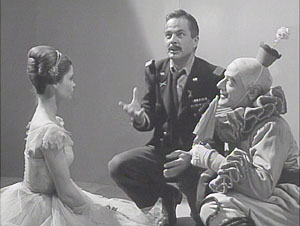
Five Characters in Search of an Exit is one of the most incredibly silly episodes of The Twilight Zone, even though the eponymous characters, for the most part, act very seriously throughout, and its plot description sounds like the set-up of a bad joke: a clown, a ballerina, a hobo, a bagpipe player and a military officer find themselves inhabiting a tall cylinder, rather than walking into a bar, with no memories of who they are or how they got there. It's an intriguingly simple and mysterious premise, and the episode plays out as one of the series' most self-conscious and autocritical; as the audience watches and begins to hypothesizing as to what might be going on, the characters join in as well, ticking off the various theories, including the obvious and the more complex, and quickly dismissing them, frustrating the audience by relentlessly teasing them as their attempts to make sense of the episode are smarmily discarded by a playful Serling. "We don't actually exist"; "we're characters in a dream"; "we're on a spaceship"; etc. until the clown declares there can be no other reasonable explanation other than that they are in Hell.

I suppose he's not too far off; the suspense builds right up until the end (although like many episodes of The Twilight Zone it'd be more effective, particularly on repeated viewings, at an abbreviated running time) as the newly arrived officer, played with desperation by the notable William Windom, passionately inspires his resigned fellow prisoners to attempt escape; they stand on one another's shoulders, and when Windom finally gets over the canister top, he slips and falls into a mound of snow. It's revealed that they are all dolls, thus their cartoonish archetypes, inhabiting a charity toy collection drive barrel. Oh. I guess you could argue the episode is a metaphor for the way that human beings find themselves trapped in a prison of their own complacency, how our world is a narrow loveless hell populated by people defined by nothing more than their profession, but it's hard to shake the feeling that this isn't anything more than a half-assed concept Serling got while staggering home drunk past a bell-ringing Salvation Army major. It's cleverly done, but deliberately so absurd as to surprise even the most hardened Twilight Zone veteran that the twist feals cheap and unduly snarky.

For Netflix purposes:
On Vol. 21 of Image Entertainment's Twilight Zone DVDs.

2.06 "The Eye of the Beholder"

Season Two, Episode Six

Written by: Rod Serling
Directed by: Douglas Heyes

The Eye of the Beholder, as in where beauty is, is one of The Twilight Zone's most well-known and beloved episodes, and not without good reason; it's well-written, impressively executed, and packs a legendary twist, even though on repeated viewings it can be a bit tiresome—just take those damn bandages off already! While ostensibly it's a simple fable, an allegorical reaffirmation of the old adage's veracity, it plays out more as a thinly-veiled critique of American racism, specifically the policies, in certain quarters, of segregation.

Janet Tyler (the voice of Maxine Stuart, later the body of Donna Douglas) is introduced with her face wrapped entirely in bandages, and she remains obscured in this manner for the bulk of the episode, a formidable acting challenge that the lovely-voiced Stuart handles finely with Olivierian gesturing. She's lying in a hospital bed, where she has received "injections" meant to alter her appearance; we learn from the dialogue that she is hideously ugly (one nurse histrionically declares if she had the patient's face she would, "go bury herself in a grave somewhere") in a fictional and assumedly futuristic society that won't tolerate such physical aberrations. If the injections haven't taken this time—this is her ninth attempt—then she is likely to be shipped-off to live with other people as ugly as she. Though, at least while in public, the nosocomial staff argues that this is awfully generous of the State, Tyler protests, apostatically shouting, "the State is not God!" and insisting they have no right to cut her off from ordinary society and the sweet smell of garden flowers.

While the phrase "the State" sounds like Communist argot and may hint at Cold War patriotism, enough to trick the censors, it's ultimately misleading and the phrase is better understood with an "s" at the end, as in those United; similarly, though the appearance of "the Leader" on ubiquitous television screens during the finale hint at fascism, and Hitler specifically in the speeches about the need for homogenous appearance (akin to racial purity), it's clearly meant to bring to mind the ranting of racist Southern politicians, namely the rhetoric of certain Senators and governors and thusly, exaggeratedly, likening Strom Thurmond to Das Fuhrer. Aired in 1960 in the midst of the struggle for Civil Rights in America—six years after Brown v. Board of Ed and four years before the Civil Rights Act on the one hand and George Wallace's presidential candidacy on the other—The Eye of the Beholder functions as a cautionary tale about the character of Dixiecrat domination, about the inevitable consequences of segregationist policy—a profoundly unjust world of arbitrary distinction, as demeaning to the US Constitution as a George W. Bush presidency. The episode's original title, A Private World of Darkness (which still appears at the end of the version in syndication) takes on a weighty double meaning when "darkness" is understood as a description of the color of one's skin.

When Janet's bandages are finally removed—slowly and with unbearable suspense in a nearly five minute sequence—it's revealed that she is in fact Donna Douglas, an undeniable beauty, and the self-declared "normal" doctors are mutilated monstrosities, porcine-faced deformities by our usual human standards. (Credit is due to the episode's careful choreography under director Douglas Heyes, who cleverly bathes the episode in shadows and successfully prevents the great revelation until the very end.) As in another episode, The Masks—except here on a cultural, rather than just an individual, level—the characters' subficial ugliness of character is determinatively manifest right on their faces.

For Netflix purposes:
On Vol. 43 of Image Entertainment's Twilight Zone DVDs.

Tuesday, June 19, 2007

5.02 "Steel"

Season Five, Episode 2

Written by: Richard Matheson
Directed by: Don Weis

An inventive take—as though, from The Twilight Zone, you would expect anything less—on the John Henry legend, Steel opens on a bustling small-town street, where a Greyhound bus is pulling up. Two men, "Steel" Kelly (Lee Marvin) and Pole (Joe Mantell) disembark wheeling what looks like a restrained, Hannibal Lechter style, mental patient. Upon closer inspection it resembles, perhaps, a wrapped-up mannequin, but whatever it is it's creepy as hell; the obvious elephant in the room, writer Richard Matheson takes his sweet time addressing it, and no passersby or fellow bar patrons—the two men have stopped off for a top off—acknowledge that anything might be out of the ordinary.

Kelly and Pole bicker like an old married couple, a spirit of combativity that continues throughout the entire episode. These are two men obviously together a long time, deeply in love, platonically, but buckling under the pressure of their dire straits. After a drawn-out, snarkily cryptic conversation about a need for parts and repairs, a bit more becomes clear—Kelly is a "manager", Pole is a mechanic, and the neatly wrapped-up mystery man is a robotic pugilist, or more accurately an android, as Serling corrects in the opening voice-over. The year is 1974 (the episode was broadcast in 1963) and boxing matches between two lumps of living flesh has been outlawed since 1968, when the expression "fists of steel" went from figurative to literal. Pole and Kelly have an outmoded B2 roboboxing model, by the memorable name of Battling Maxo, and have traveled from the East (Philly) to the West, Nowheresville to be exact, aka the fictional town of Maynard, Kansas, for just about the only bout they can book. No one's battled anything less than a B4 in years, they're told—as if they didn't already know!—but with Kelly's passionate commitment to their fighter and Pole's passionate commitment to Kelly, they prepare for a battle with a vastly superior B7.

Not only are they lugging around an inferior model, though, but it's in desperate need of repairs and new parts, which they can't procure, if they could even afford them, since nobody uses B2s anymore. (Akin to my trouble finding a typewriter ribbon, I suppose.) Kelly, though, is foolhardily fixed on going through with the fight; Matheson's script, in a consequence of the medium's prescribed brevity, largely underplays Kelly's motivations, but Marvin picks up the slack, three-dimensionalizing the character by delivering a moving show of desperation and a sympathetic, regretful understanding of his own obsolescence; Kelly, as he explains in a movingly pathetic scene, used to be, back in the day, a blood-and-bones boxer, and they nicknamed him Steel because he never got knocked down, no not once. Replaced by machines, like many a worker, Kelly finds himself with nothing to do but wheel around a hunk of metal as outdated as himself. He tries to brag about his glory days to the manager of the stadium and his money-counter, but they never heard of him and they could care less—they've got work to do and cigars to chew—and Marvin is reduced to just another sad, rambling old man, the sort that should've been washed away years ago and now wanders an earth wherein he no longer belongs.

So he slunks off with Pole, since they've got some work of their own to do, like getting Battling Maxo (love that name!) ready for the fight. "We got ourselves a piece of dead iron here," Pole insists, trying to drive home a point that Kelly just won't acknowledge—the robot needs repairs and he can't fight. But Kelly insists they'll go through with the fight, and then be able to use the money they make to not only get back on their feet, but to get Maxo back on his feet, too; in a symbol of his deteriorating state, a wheel on his right foot keeps popping off. After a few minutes of preparatory sparring, a spring pops loose from Ol' Maxo and leaves the two men with nothing but a busted and irreparable robot. Kelly refuses to believe they can't get the parts until Pole finally breaks down screaming. "Dontcha understand?" he pleads with the monomaniacal Kelly, "they don't make 'em anymore!"

Well, that's that then, I guess. So, whatta you wanna do tonight, Kelly? But rather than offer the familiar, "I don't know whatta you wanna do?" Kelly madly decides that he'll fight, in defiance of the law. "You'll get killed!" Pole protests, to which Kelly replies, cool as a cucumber in a moment of suicidal fanaticism, "then I will." Kelly needs the money, but he also needs to prove to himself that he's still "got it in him", so to speak, that not even a machine could knock down the super man they called Steel. Moreso, he needs to prove to himself he's not as broken down as that feeble machine, that he still matters. So, unbeknownst to the crowd and owners, it'll be "Steel" vs. steel in an allegorical supermatch; as the children will sing, Steel Kelly, Steel Kelly was a steel-punchin' man, Steel Kelly was a steel-punchin' man, man, man...Kelly, painted-up to look palely mechanical, is of course nearly beaten to death by his opponent, the soulless automaton, after about only two minutes of fighting; watching that supergadget bear down on that poor man, his humanity oozing out of his face in dark red puddles, is heartbreaking if not terrifying, as the robot's emotionless rubber-face and Stepford eyes (halved Ping Pong balls, painted black) are the stuff of nightmares. (And Van Cleave's deliriously atmospheric score, from darkly swinging jazz to frenetic string lines, only makes it creepier.) The crowd jeers, "get that pile of junk outta here!" and though they think they're gibing a robot, their characterization is apt. Kelly's in over his head; he's just an old piece of junk.

The man who never fell has been felled, proving, in the general sense, that even the strongest man can't compete with the strongest machine; in a more specific sense, Kelly has realized he's licked...this time, at least. Pole wheels him back to the locker room, where he immediately and dramatically collapses to the floor. "Did you get the money?" Kelly eventually manages to muster through his broken, bloodied teeth. Only half, Pole admits; after all, he only went one round instead of the agreed-upon six. Kelly protests but Pole quashes it; forget it, Kelly, it's Maynard, Kansas. While Matheson's script points towards a tragic defeat of man by machines and, by implication, of age by youth, Serling offers a glimmer of hope in his closing narration; though he points out the tale is "proof positive that you can't outpunch machinery," he offers an inspirational caveat: "proof also of something else: that no matter what the future brings, man's capacity to rise to the occasion will remain unaltered. His potential for tenacity and optimism continues, as always, to outfight, outpoint and outlive any and all changes made by his society." Kelly may not be dancing around the ring—he may be a broken hunk of Steel rather than gloating over one—but hey, he's still alive and he's got $250 to show for it. Men can do one thing that popped-spring machines and mere boys can't do, and that's to keep on keeping on.

For Netflix purposes:
On Vol. 3 of Image Entertainment's Twilight Zone DVDs.

Wednesday, June 6, 2007

3.21 "Kick the Can"

Season 3, Episode 21

Directed by: Lamont Johnson
Written by: George Clayton Johnson

George Clayton Johnson was wise beyond his years, spending the early '60s—when he was only in his thirties—writing a string of moving and mature teleplays on the nature of aging and death; indeed, the first story he ever sold was entitled, "All of Us Are Dying", a blunt statement that just about sums up the mortality-obsessed worldview expressed in his writings. His first episode of The Twilight Zone's third season, Nothing in the Dark, deals with an elderly woman's coming to terms with her own imminent demise, but frankly, though sweet, it's a tad cloying in the way it plays out. (Read our review of it here.) His next episode, Kick the Can, threatens to succumb to the same sort of sappiness, but through a last minute reversal of tone it becomes an effectively tragic tale about loneliness and the forsaken character of old age.

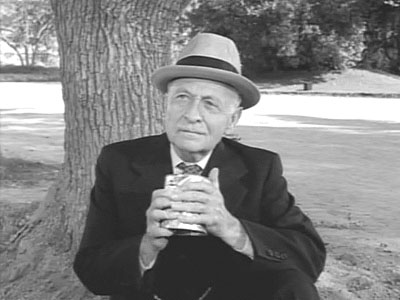
Charles (Ernest Truex, fiesty) may have a bed at Sunnyvale Rest on Tranquility Lane, but he doesn't quite live there, if you know what I mean. Surrounded by zonked-out, senile and half-blind droolers, he still has a spunk about him and an unwillingness to go gently into that good twilight of soup and half-a-sandwich lunches. Against the backdrop of stationary senescents that opens the episode, tow-headed kids are seen playing the children's classic kick-the-can. Charles spots their can and selfishly steals it, against the protests of the children. "Hey mister, that's our can, we're playing with it," one pleads, but Charles, gripping it madly with a far away look in his eyes, is completely oblivious to his imploration.

That's because he's suddenly too preoccupied with pondering the nature of age. Is age an effect of time, or is it merely a state of mind? Charles is fascinated by the idea that the Fountain of Youth might be just a way of thinking, but his cantankerous roommate and lifelong pal Ben (Russell Collins) wants no talk of such silliness. He peers out the window, crotchetily complaining about those dang noisy kids, loud enough to "wake the dead", or at least just the elderly fusspots near death living at the home. Charles is more forgiving, admiring their sense of play and remarking, in reference to the retirement home's grounds, "kids can't resist going where the grass is." (Certainly a cleverly subtle joke from well-known marijuana-legalization advocate Johnson.)

In contrast to the playing children, Charles' fellow septua- and octo-genarian housemates are nothing but "vegetables on a porch", seemingly unflappable until something happens—then they're all nosy and crabby commentators in typical senior citizen fashion. "Let him drown himself if he wants," one remarks of Charles as he dances in a sprinkler.

"We all get old," is the repeated, defeatist refrain that Charles just cannot accept; he becomes convinced that the secret to juvenescence is in play, and that a game of kick-the-can will restore their youth. "[But] I can't play kick the can alone!" he entreats his fellow residents, with a fervor on par with Howard Beale. "Wake up! This is your last chance!" Or, "I want you to get up, and go to your windows, and shout, 'I'm old as hell, and I'm not gonna take it anymore!'"

Preceding this outburst is a rather touching scene as the old timers discuss the changes that accompany old age. "It's the running I miss the most," one remarks, to which another woman agrees. This coaxed-out spirit of mournful melancholy is what ultimately inspires all the seniors to finally agree to play Charles' game. All but Old Ben, that is, who wants nothing to do with it; Ben won't go because, as Charles asserts, he's afraid—afraid to look foolish, afraid to make a mistake; Johnson, playing up a prominent theme from Nothing in the Dark, is saying that it's not only a surrendering-to-the-inevitable mindset that makes people "old", but that it's a driving sense of fear, the sort that adults of any age often feel and what ultimately separates them from their youthful counterparts. Eventually, Ben rouses the home's president, played by notable character actor John Marley (who got a bedful of horse's head in The Godfather), and asks him to put a stop to this foolishness.

Of course, when they get outside there are no old folks, just children at play. It worked! Charles was right, there is still magic in the world! This expected and inevitable happy ending almost makes Kick the Can nothing more than pleasant and well-acted feel-good fare, but then comes the tragedy--Ben, now the only old person left, begs his old friend Charles, now a young boy, to take him with them, to restore his youth. The small boy stares frightenedly at Ben, before simply running off to Ben's despair, a moment of devastating abandonment later revisited by Serling in On Thursday We Leave for Home. But the scene mirrors the opening scene, in which Charles thinks he is leaving the rest home to live with his son. When his son arrives there's a single line: "I didn't say you could come home, I said we'd talk about it." Charles exits from his son's car, understanding Sunnyvale is now his final stop on the merry-go-round of life. Charles' son abandons him, just as Charles abandons Ben, because that's what children do; that's where Kick the Can's true pathos lies.

For Netflix purposes:
On Vol. 3 of Image Entertainment's Twilight Zone DVDs.